
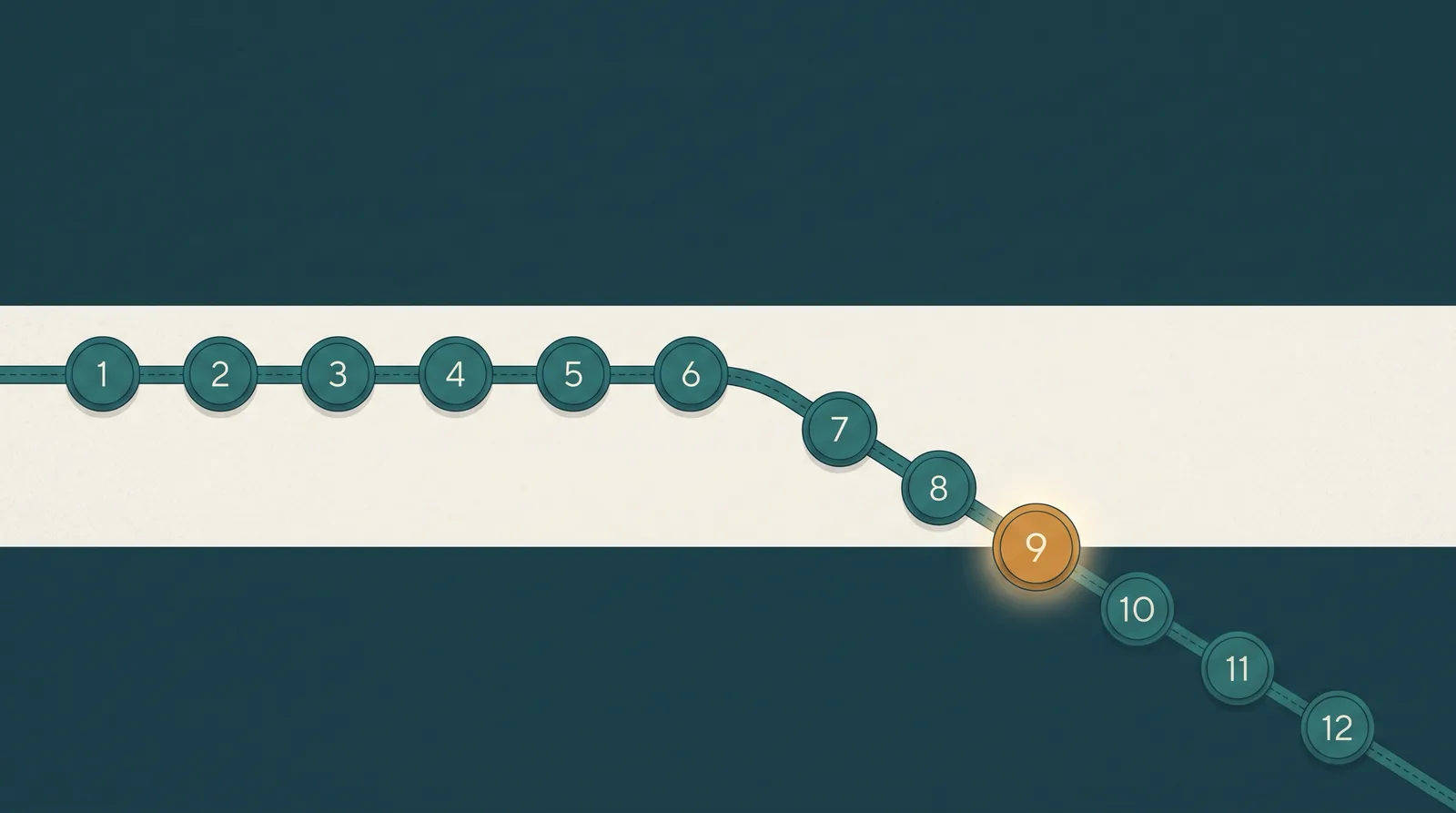
Taking a roofing company public is a 12-step process that spans 18–30 months and costs real money before you see a dollar of IPO proceeds. This playbook maps the actual procedural sequence — from getting your financials audit-ready to surviving your second year as a reporting company — so you can decide whether the work is worth it before you start it.
Prerequisites
Confirm all five of the following before Step 1, or stop reading:
- EBITDA ≥ $30M with a credible path to $50M+ by listing date. Below this, the cost of being public likely exceeds the benefit for a services company.
- Revenue scale. WilmerHale's 2024 IPO Report puts the floor for IPO-ready revenue at $50M–$75M annually. Roofing margins are thin; err toward the high end.
- Clean corporate structure. No tangled family-partnership arrangements, no unresolved material litigation, no revenue concentrated in one customer you can't explain to an analyst.
- A strategic reason to be public. Acquisition currency, PE exit, founder liquidity, or roll-up capitalization. "The bankers said we should" is not a reason.
- Owner commitment. The CEO and CFO will be unavailable for other work for roughly six months during the active process.
The 12 steps
Step 1: Audit your last three years of financials to PCAOB standards
Engage a PCAOB-registered audit firm immediately. Per Deloitte's IPO Roadmap, an Emerging Growth Company can file with two years of audited statements; all other issuers need three. Either way, start now — financials go stale 134 days after the balance sheet date, and a missed window pushes your IPO back a full quarter.
- Confirm your current auditor is PCAOB-registered. Regional firms that handle private companies often are not, and the SEC's Division of Corporation Finance notices.
- Reconcile books to GAAP. Owner perks, related-party rents, and informal revenue recognition all get cleaned up here — not during SEC review.
- Produce income statement, balance sheet, cash flow statement, and statement of changes in equity for each audited period.
- Identify material weaknesses in internal controls. These require disclosure in the S-1 and remediation before the auditor issues a clean opinion.
Step 2: Hire a public-company CFO and restructure the C-suite
Your current CFO may be excellent at running the private operation. The question is whether they have closed a public-company quarter — SOX compliance, audit committee presentations, and analyst calls, all on a 45-day clock. If they haven't done it, hire someone who has.
- Post the CFO search no later than 18 months before your target IPO date. The best candidates want to be part of the build, not parachuted in at the end.
- Define the role clearly: this CFO must be comfortable in front of institutional investors. The roadshow is a live Q&A sprint where the CFO fields financial questions under pressure.
- Evaluate your General Counsel and Chief Accounting Officer. You need legal counsel who has handled securities filings and a CAO with public-company close experience.
- Brief your outgoing CFO on the transition. Many become effective Controllers or VP Finance — the org can expand without a casualty.
Step 3: Build the board and governance framework
NYSE and Nasdaq both require a majority of independent directors. New IPO companies get a 12-month phase-in from listing date, but recruit your independent directors before the S-1 is filed — not while the SEC is reviewing it.
- Identify 2–3 independent director candidates. At least one should carry public company CFO or CEO experience, M&A background, or relevant industry expertise.
- Constitute an Audit Committee with at least one Audit Committee Financial Expert as defined by the SEC. GAAP and financial reporting literacy required.
- Constitute a Compensation Committee of independent directors.
- Adopt board and committee charters plus a code of business conduct. These are attached as exhibits to the S-1.
- Secure D&O insurance before the S-1 is filed. Directors of newly public companies are named in securities class actions by default.
Step 4: Conduct a readiness assessment and build the data room
A readiness assessment gaps you across six dimensions: finance, governance, legal/compliance, HR/compensation, IT systems, and investor communications. EY recommends starting this process 12–24 months before the target listing date. The data room closes those gaps and becomes the foundation of underwriter due diligence.
- Engage outside counsel or a Big Four advisory team to run the assessment against an IPO readiness checklist.
- Populate a virtual data room with: entity structure charts, material contracts, employment agreements, IP documentation, insurance schedules, litigation summaries, three years of financials, and month-by-month management accounts.
- Resolve structural issues before the underwriters see them. A related-party transaction that surfaces in diligence requires disclosure and explanation in the S-1.
- Define your investor KPIs. In roofing: revenue per crew, average job size, customer acquisition cost, warranty claim rate, and regional revenue concentration.
- Build your equity story now: why is this company public? What is the total addressable market? Why does this management team win? This narrative becomes the S-1 business section and the roadshow deck.
Step 5: Select your underwriters and assemble the working group
The underwriter bakeoff formally starts the IPO clock. Once you select your lead bookrunner and hold an organizational meeting, you are "in registration" — SEC gun-jumping restrictions on public statements apply from that moment forward.
- Invite 3–5 investment banks to pitch. Evaluate on: sector expertise in services companies, research analyst quality, institutional investor relationships, and proposed valuation range.
- Select a lead bookrunner and one or two co-bookrunners. For a mid-market roofing company, boutique advisors with sector-specific expertise often outperform bulge brackets on valuation positioning.
- At the organizational meeting, assemble the full working group: company management, securities counsel, underwriters' counsel, auditors, and financial printer.
- Execute lock-up agreements with major shareholders before the org meeting.
- Per Mintz's Chronology of a US IPO, the formal process from organizational meeting to pricing runs approximately four months. That clock starts at the bakeoff.
Step 6: Draft the S-1 registration statement
The S-1 is the most consequential document your company will produce. It describes your business, discloses your financials, lists risk factors, and makes the case to investors — in legally precise language that becomes the basis for securities liability. From org meeting to first confidential submission: 4–6 weeks of intensive drafting.
- Hold weekly drafting sessions with the full working group. Management must direct the business and MD&A sections — don't let counsel write them by default.
- The S-1 must include: business description, MD&A, risk factors, audited financials, capitalization table, use of proceeds, underwriting structure, and executive compensation.
- For an Emerging Growth Company, confidential submission is available under the JOBS Act. Per Deloitte's IPO Roadmap, this lets you resolve SEC comments before your draft is public — a significant competitive and strategic advantage.
- Draft risk factors honestly. Under-disclosed risks found during SEC review cause delays and post-IPO litigation exposure.
- Engage a financial printer (Donnelley, Toppan Merrill) early. They format and file EDGAR submissions and are on the critical path.
Step 7: Navigate SEC comment cycles
After your confidential submission, the SEC delivers its first set of comments within 30 calendar days. Expect 2–4 rounds. Each subsequent round takes roughly two weeks.
- The first comment letter will typically run 30–60 line items: disclosure clarifications, accounting questions, segment reporting challenges, and non-GAAP reconciliation requirements.
- Respond to every comment in writing. Each response either amends the S-1 or argues why the existing disclosure is compliant.
- Common comment areas for services companies: revenue recognition methodology, related-party transactions, segment reporting, non-GAAP metric reconciliation, and use of "key business metrics."
- Track the 134-day financial statement staleness window carefully. If the process extends past that mark, you need updated financials — which may require a new audit.
- Conduct "testing the waters" meetings with qualified institutional buyers during this window to gauge investor appetite before the roadshow is locked.
Step 8: File publicly and execute the roadshow
Public filing triggers a 15-day window before roadshow launch. All prior confidential submissions become public simultaneously. The roadshow itself runs 4–7 days of back-to-back one-on-ones and group presentations with institutional investors.
- File the public S-1 at least 15 days before roadshow launch, including the price range. This is your opening bid in the valuation negotiation.
- Prepare a 30–45 minute management presentation: equity story, financial performance, competitive position, and growth plan. Rehearse until the CEO delivers it under pressure without notes.
- The bookrunner manages the schedule: New York, Boston, San Francisco, and typically one or two international cities for larger deals. Expect 6–10 one-on-one meetings per day.
- The bookrunner simultaneously builds "the book" — taking indications of interest from institutions. Oversubscription at 2–3x is the target.
- Maintain radio silence on public statements during the roadshow. Any material disclosure not made through the S-1 creates securities law exposure.
Step 9: Price the IPO and begin trading
Pricing happens the evening after the roadshow closes, in a call between management, the lead bookrunner, and counsel. The final IPO price is set from the book of demand — how many shares institutions indicated interest in buying, at what prices.
- Bring-down diligence on pricing night: underwriters confirm no material changes since the last S-1 amendment. Management certifies. This is the last gate before trading.
- Execute the underwriting agreement. Underwriters formally commit to purchase shares at the IPO price for resale to the public.
- The standard 180-day lockup takes effect at pricing. Pre-IPO shareholders are prohibited from selling until day 181.
- File the final prospectus (424B4) within two business days of pricing.
- Comparables matter for calibration: ServiceMaster Global Holdings (NYSE: SERV) priced its June 2014 IPO at $17 per share — below the $18–21 range — raising $610M, with J.P. Morgan, Credit Suisse, Goldman Sachs, and Morgan Stanley as joint bookrunners. The below-range pricing was a signal that valuation discipline prevailed over banker optimism. A clean pricing that opens 10–15% higher in aftermarket trading beats an overpriced deal that slides for six months.
Step 10: Execute your first quarter as a public company
The first 90 days are an operational stress test. Form 10-Q is due 45 days after the end of your first fiscal quarter as a public company. The CEO and CFO personally certify each quarterly filing under SOX Section 302.
- File Form 10-Q within 45 days of quarter-end (non-accelerated filer) or 40 days (accelerated filer). Missing this deadline creates SEC enforcement exposure and can disqualify you from simplified registration forms.
- Implement SOX Section 302: design and evaluate disclosure controls and procedures, then certify they work. This is a process, not a checkbox.
- Begin building toward SOX Section 404(a): management's annual assessment of internal control over financial reporting. This appears in your first annual 10-K.
- EGCs are exempt from Section 404(b) auditor attestation until they exit EGC status. Use this window to build the controls infrastructure at your pace.
- SOX compliance costs average $1M–$2M per year, with 30% of established public companies spending more than $2M annually. Budget it before listing, not after.
Step 11: Run your first earnings call
Your first earnings release is the most consequential quarterly moment you will have. Analysts have set expectations based on your roadshow guidance. The first miss typically costs 15–25% of market cap in a single session. Beat with raised guidance and you establish the "beat and raise" cadence that defines strong aftermarket performance.
- The annual 10-K is due 90 days after fiscal year end (non-accelerated filer). Prepare it in parallel with earnings release preparation — the disclosures overlap substantially.
- Write the earnings script in advance: CEO opening (business update), CFO financial review (revenue, EBITDA, cash flow, guidance), and prepared Q&A for the questions you know analysts will ask.
- Any non-GAAP metric disclosed on the earnings call must reconcile to GAAP under SEC Regulation G. Post the reconciliation on your IR website at the time of the call.
- Prepare for roofing-specific analyst questions: job-cost variance, crew productivity, material costs, warranty claims, M&A pipeline, and seasonal patterns.
- Record and post the transcript or replay. The language you use in Q1 sets the template for the next twelve quarters.
Step 12: Navigate year two — lockup expiration, analyst coverage, and EGC status
The 180-day lockup expiration is the first major post-IPO inflection point. Pre-IPO shareholders become free to sell. How you manage that window, analyst coverage, and the transition out of EGC status determines whether your company becomes a sustained public-markets performer or a one-year story.
- Monitor the lockup expiration date. Work with your IR team and underwriters on a coordinated secondary offering if major shareholders plan to sell. An uncoordinated expiration can move the stock down 20–30% and damage institutional relationships.
- Cultivate analyst coverage. The lead bookrunner's research team publishes initiating coverage roughly 25 days after IPO (after the quiet period). Engage sell-side analysts proactively — they are your intermediaries to the institutional investor base.
- Track EGC status annually. The revenue threshold is $1.235B; you also exit upon the fifth anniversary of your IPO, issuance of more than $1B in non-convertible debt over three years, or becoming a large accelerated filer. When you exit, Section 404(b) auditor attestation applies — budget $500K–$1M in incremental audit fees.
- Develop a capital allocation framework for investors: dividends, share buybacks, or organic and acquisition reinvestment. Public markets want to know what you will do with the cash you raised.
- Consider an at-the-market equity program or follow-on offering if the stock price is strong and the acquisition pipeline is active. Capital access is the primary structural advantage of being public. Use it.
Common pitfalls
- Underestimating PCAOB audit prep time. Private roofing companies often carry three to six months of accounting cleanup before an auditor can issue a clean opinion. Start 24 months out, not 12.
- Hiring the wrong CFO. A CFO who built great P&Ls for a private company is not the same as one who can manage the quarterly reporting machine, talk to analysts, and certify SEC filings. The skill sets overlap but are not identical.
- Pricing greed. ServiceMaster priced its 2014 IPO below the range and still raised $610M. Companies that insist on the top of the range sometimes watch the book collapse. A clean pricing beats an overpriced deal that slides for six months.
- Neglecting post-IPO compliance infrastructure. SOX compliance averages $1M–$2M per year. Treating it as a checkbox costs more in remediation than building the infrastructure correctly at the start.
- Ignoring the lockup expiration. Multiple major holders selling simultaneously without coordination destabilizes the stock. Plan the secondary or coordinate waivers before day 181 arrives unmanaged.
Definition of done
- Your company is listed on NYSE or Nasdaq.
- Two full earnings calls are complete and guidance is issued for the next quarter.
- A 10-K and at least two 10-Qs are filed without material restatements.
- SOX 302 certifications are in place for all filed reports.
- Analyst coverage from at least three sell-side firms is active.
- The 180-day lockup has expired and any secondary activity was managed in an orderly, coordinated process.
Next in the series: How to build an S-1 that actually gets read — inside the registration statement, section by section.